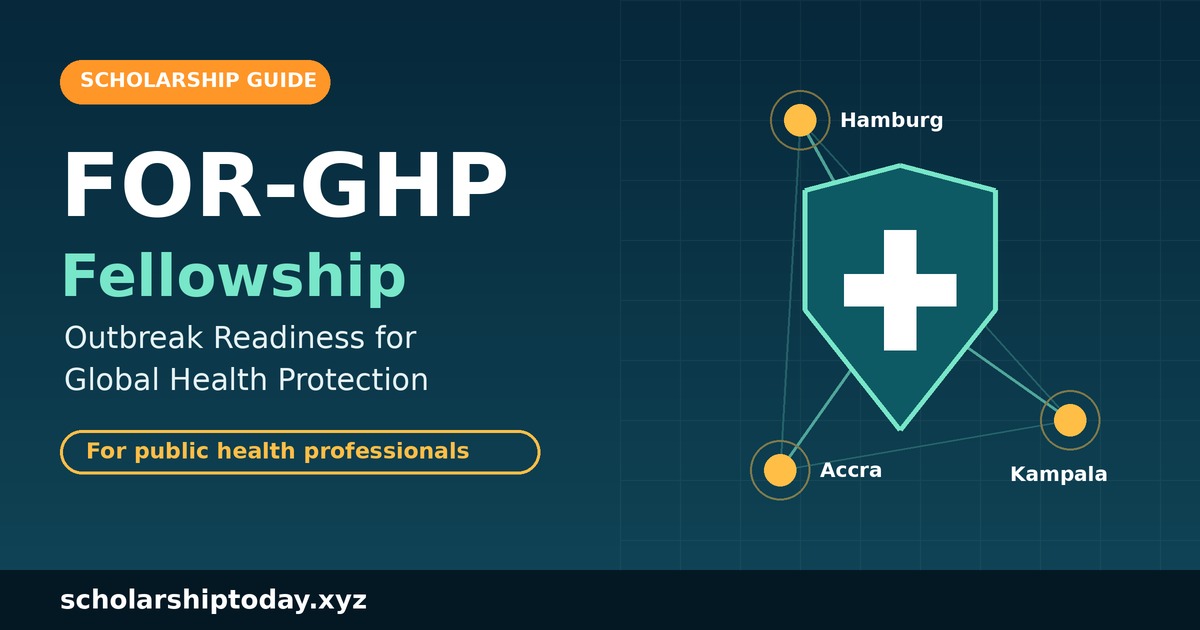
If you work in public health in sub-Saharan Africa and want to lead your institution’s response to the next outbreak, the FOR-GHP Fellowship is built for you. It is a funded training-of-trainers programme on outbreak readiness, run by a consortium of African and European public health institutes. It is not a degree. It is a roughly 1.5-year fellowship that combines online learning with three one-week workshops in Hamburg, Accra and Kampala. There are no tuition fees, and the programme covers your flights, visa fees and accommodation for the workshops.
This guide explains what the FOR-GHP Fellowship covers, who qualifies, how selection works and how to avoid the mistakes that sink strong applications.
What Is the FOR-GHP Fellowship?
FOR-GHP stands for the Fellowship in Outbreak Readiness for Global Health Protection. According to the programme, its goal is to strengthen outbreak management skills, with a focus on One Health and global health security, and to train local experts who can act as multipliers for regional impact.
The programme’s stated objectives are to:
- Build fellows’ competence in outbreak management through digital and in-person methods, including simulations.
- Train experts as facilitators, multipliers and leaders in their institutions and countries.
- Build a regional network for knowledge exchange and coordinated responses.
- Keep the impact going through an alumni network for collaboration, mentorship and peer learning.
It is funded by the German Federal Ministry of Health through the Global Health Protection Programme. The consortium includes the Africa Field Epidemiology Network (AFENET), the Robert Koch Institute in Germany, the Swiss Tropical and Public Health Institute, and the Bernhard Nocht Institute for Tropical Medicine in Hamburg. The funding period runs from 2026 to 2028.
Key Benefits: What the Fellowship Covers
According to the programme’s information page:
- No tuition fees.
- Economy-class flights, visa fees and accommodation for the three in-person workshops.
- Daily meals during the workshops.
- A certificate and 10 ECTS points from the University of Basel for completers, for 300 hours of study.
The programme says it does not pay per diems, so you shouldn’t expect a daily allowance or stipend. Budget for your own incidental costs, such as local transport, phone data and anything you spend between workshops.
Beyond the money, you get structured training in outbreak management, practice leading a teaching case study at your own institution and entry to an alumni network across the region.
Who the Fellowship Is For
Early-career and mid-career public health professionals
This is the core group. The programme is for people who already work in public health or the biomedical sector, not for students still in full-time study.
Postgraduate-trained professionals
You don’t need a master’s degree, but you do need a relevant degree or proven proficiency, plus at least two years of professional experience.
Not for undergraduates
If you’re an undergraduate student with no work experience, you don’t meet the experience requirement. Look at other opportunities first, and come back when you’ve worked in the field.
Educators and trainers
Because this is a training-of-trainers programme, people who teach, supervise or mentor colleagues in outbreak response are a natural fit.
Detailed Eligibility Criteria
According to the programme’s official application page:
- Origin and employment: you must have origin in sub-Saharan Africa and be employed there.
- Experience: at least two years of professional experience in public health or the biomedical sector, preferably in infectious disease management, prevention or control.
- Qualification: a degree or proficiency in public health, medicine, epidemiology, microbiology, biology or allied health sciences.
- English: advanced proficiency, shown by one of the following:
TOEFL paper 550, TOEFL computer 213 or TOEFL internet 79 to 80
IELTS 6.0
native-speaker status
completed higher education in English, with written proof
- Equipment: a computer with a stable internet connection, and working audio and a microphone. Phones and tablets are not permitted.
- Employer support: your employer must confirm it will release you for the three workshops and support you in implementing case studies.
- Inclusion: the programme says all gender identities are strongly encouraged to apply.
One third-party summary also mentions proof of your degree or relevant qualification. The official page I read doesn’t list it separately, so check the application form.
Step-by-Step Application Process
- Check your eligibility. Confirm your country of origin, work experience, English proof and equipment.
- Talk to your employer now. You need their written endorsement, and it uses the programme’s template.
- Ask your referee. You need a letter from at least one current, contactable referee, issued within the last three years.
- Write your motivation letter. It must be a PDF, in English.
- Complete the online application form. The programme uses an online portal. Email and paper applications are not accepted.
- Upload everything electronically. Incomplete applications will not be considered.
- Submit before the deadline.
- If selected, complete the eLearning modules from 1 December 2026 to 1 January 2027.
- Attend the interview in January 2027.
- Sign the learning contract if you’re chosen as a fellow.
How selection works
The programme describes three stages:
- Stage 1 (December 2026): the steering board admits applicants to the first seven eLearning modules.
- Stage 2 (January 2027): selected applicants are assessed on a pre-qualification test covering the modules, a short essay and other criteria. Shortlisted candidates have a one-to-one English interview over Zoom.
- Stage 3: final fellows are chosen based on the interviews. A signed learning contract completes admission.
The seven eLearning modules are graded as part of selection, so treat them as part of the application, not as a warm-up.
Required Documents Checklist
According to the official application page:
- Completed online application form
- Motivation letter: PDF, in English
- Employer endorsement: on the programme’s template, confirming release for the three workshops and support for implementing case studies
- Letter of recommendation: from at least one current, contactable referee, issued within the last three years, with email and phone number
- Proof of English proficiency: a test score, native-speaker status, or written proof of higher education completed in English
Also have your degree certificate and CV ready. A third-party summary says proof of your degree may be requested, though the official page doesn’t list it separately.
Important Deadlines and Timeline
According to the programme’s official page:
- Application deadline: 21 October 2026, midnight CET
- eLearning modules: 1 December 2026 to 1 January 2027
- Selection interviews: January 2027
- Workshop 1, Hamburg: 12 to 17 April 2027
- Workshop 2, Accra: 11 to 15 October 2027
- Workshop 3, Kampala: 3 to 7 July 2028
The page recommends booking a German embassy visa appointment in December 2026, before the outcome is known, because visa processing can take a long time. If you wait for the result, you may not have time.
A realistic plan
- Today and tomorrow: if you haven’t started, finish your documents and submit. Don’t wait for the final hour.
- December: if you’re admitted to the eLearning modules, set aside time every week.
- January: prepare for the Zoom interview in English.
- April: workshop in Hamburg, if you’re chosen.
Common Mistakes to Avoid and Insider Tips
Mistakes
- Submitting at the last minute. “Midnight CET” is easy to misread, and portals slow down near deadlines.
- Forgetting the employer endorsement. It must use the template, and it’s a required part of the file.
- An old recommendation letter. It must be no older than three years, and your referee must be contactable.
- Using a phone or tablet. The programme says only a computer is acceptable for participation.
- Sending incomplete applications. The programme says they won’t be considered.
- Underestimating the eLearning stage. The modules are graded as part of selection.
- Waiting for the result before arranging the visa. The programme recommends booking early.
Insider tips
- Write a specific motivation letter. Name an outbreak you’ve worked on, what you learned and what you would teach colleagues.
- Show your multiplier plan. This is a training-of-trainers programme, so explain how you’ll pass skills on at your institution.
- Choose a supportive referee. Pick someone who has seen your outbreak or public health work.
- Talk to your employer about the case study. The fellowship involves developing and piloting a case study, and implementing it at your home institution, so your employer needs to back that.
- Test your internet and audio. Check your equipment before the interview and before each online session.
- Apply for other routes too. The next step might be a degree or a different fellowship. Compare options such as the Mo Ibrahim Leadership Fellowships, the Harvard LEAD Fellowship for Promoting Women in Global Health or the Chevening Scholarships.
Frequently Asked Questions
Is the FOR-GHP Fellowship free?
There are no tuition fees. The programme covers economy flights, visa fees and accommodation for the three workshops, plus daily meals. It doesn’t pay per diems.
Who can apply?
Professionals with origin and employment in sub-Saharan Africa, with at least two years of experience in public health or the biomedical sector, a relevant degree or proficiency, and advanced English.
Is it a degree?
No. It’s a fellowship of about 1.5 years. Completers receive a certificate and 10 ECTS points from the University of Basel.
Where are the workshops?
In Hamburg (Germany), Accra (Ghana) and Kampala (Uganda).
Do I need a master’s degree?
The official page asks for a degree or proficiency in a relevant field and two years of professional experience. It doesn’t state a master’s requirement.
What English score do I need?
TOEFL paper 550, computer 213 or internet 79 to 80, or IELTS 6.0, unless you’re a native speaker or completed higher education in English with written proof.
Can I apply from outside Africa?
The programme requires origin in and employment in sub-Saharan Africa.
Do I need my employer’s approval?
Yes. You need an employer endorsement on the programme’s template, confirming release for the workshops and support for implementing case studies.
When will I know the result?
Interviews are in January 2027, with final selection afterwards. The page doesn’t give an exact results date.
Conclusion: Your Next Steps
The FOR-GHP Fellowship is a rare chance to build outbreak leadership skills, earn University of Basel credit and join a regional network, all without tuition fees. The deadline is very close, so move now:
- Confirm your eligibility.
- Get your employer endorsement and recommendation letter.
- Finish your motivation letter.
- Submit the online application before the deadline.
- If you’re selected, book your visa appointment early.
If you miss this round, watch for the next one and start preparing today.
Apply HERE: FOR-GHP Fellowship
Author’s note: Deadlines, benefits and eligibility rules can change. Please confirm everything on the official FOR-GHP and BNITM websites before you apply.