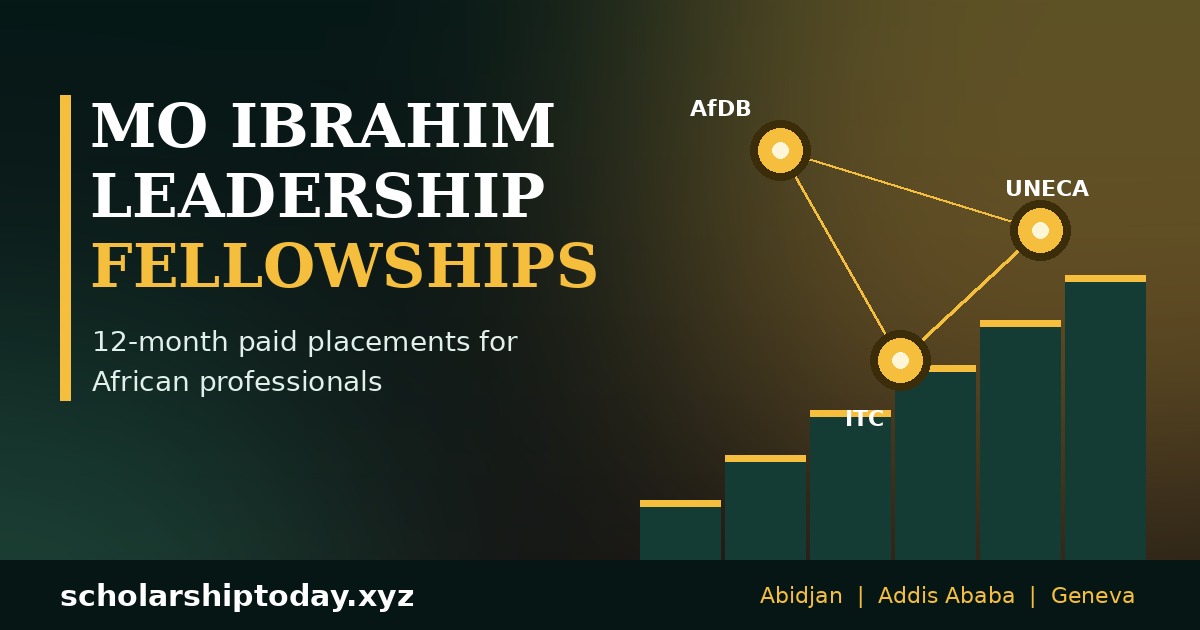
The Mo Ibrahim Leadership Fellowships are not a classroom scholarship. They are paid, 12-month placements inside the executive offices of major African and international institutions. They are meant for experienced African professionals who want to lead, not for school leavers or fresh graduates. Each year, three Fellows are placed at the African Development Bank (AfDB) in Abidjan, the UN Economic Commission for Africa (ECA) in Addis Ababa and the International Trade Centre (ITC) in Geneva. The official programme page lists a stipend of $100,000.
If you have a master’s degree, at least seven years of relevant experience and you are under 40, this guide is for you. If you are still an undergraduate or a recent graduate, it will show you what to build towards, and point you to better-suited funding. The Mo Ibrahim Leadership Fellowships are highly selective, and the 2027 call is open now, with the closing dates at AfDB and ECA falling in November. Read on, then check the official pages before you submit anything.
What are the Mo Ibrahim Leadership Fellowships?
The Mo Ibrahim Foundation set up the fellowships in 2011 to identify and mentor the next generation of outstanding African leaders. Each Fellow works directly in the executive office of a host organisation for 12 months. They contribute to research, strategy and policy design, and they get direct mentorship from the head of the host institution.
Fellows also join the Foundation’s Now Generation Network, which keeps them connected to other emerging African leaders after the placement ends.
The three hosts are:
- African Development Bank (AfDB), in Abidjan. The AfDB posting sits in the President’s office.
- UN Economic Commission for Africa (ECA), in Addis Ababa. The posting sits in the Office of the Executive Secretary.
- International Trade Centre (ITC), in Geneva.
Each host runs its own application process. That is the most important thing to understand before you start.
Key benefits: what the fellowship covers
The Foundation funds the fellowship, and the host organisation pays it out. Based on the official pages, here is what you can expect:
- A stipend. The Foundation’s page states a stipend of $100,000 for the programme. The host vacancy notices say an annual stipend is paid monthly by the host out of Foundation funds, but they do not repeat the figure, so confirm the exact amount and how it is paid in your offer documents.
- Travel for assuming duty and returning home. Both the AfDB and ECA notices say the Foundation covers these costs.
- Official mission travel. The host covers work-related travel, including travel insurance.
- Senior mentorship. You work alongside the head of the host institution and their team.
- Real policy exposure. You contribute to strategy, research and briefings at the highest level.
- Network membership. You join the Now Generation Network, and ECA’s notice says Fellows are invited to the Foundation’s annual forum.
Know what it does not cover. The AfDB notice says Fellows do not join the Bank’s medical insurance, retirement or child education schemes, and the Foundation expects you to arrange your own. ECA’s notice says the same. Budget for health cover, pensions and any family costs yourself.
It is also not a job. The AfDB notice says the post is not a regular position, the contract is for one year and is not renewable, and there is no presumption of future employment. It adds that Fellows are not eligible for recruitment as Bank staff for one year after the fellowship ends. Think of it as a career accelerator, not a hiring pipeline.
Who the Mo Ibrahim Leadership Fellowships are for
Undergraduate students
The fellowship is not open to undergraduates. The requirement of at least seven years of relevant work experience and a master’s degree rules this out. If you are an undergraduate, look at the Foundation’s separate Ibrahim Scholarships, which support aspiring African leaders at selected universities. Check that page for the current list and rules.
Master’s and postgraduate students
If you are still studying, you are not yet eligible. But this is the time to plan. A master’s degree is the minimum, and the experience requirement means you should be building a track record in policy, finance, development, trade or a related field. You can use these years to collect achievements that will make a strong application later.
Mid-career professionals and new executives
This is the target group. The official page describes the fellowships as open to young professionals, mid-career and new executives from Africa with relevant experience and a master’s degree. If you have led projects, shaped policy or managed teams, and you are under the age limit, you are the person the programme was designed for.
Eligibility criteria
The Foundation’s page lists the core rules. The host notices add detail, so read both.
1. Nationality
You must be a national of an African country. The AfDB and ECA notices both say you may be living anywhere in the world. The AfDB also states that it does not accept dual nationality and asks you to declare the nationality you want to be considered under.
2. Education
A master’s degree is the minimum.
- AfDB asks for a master’s from a recognised institution in a relevant area, such as banking, business, economics or other social sciences, finance or international development.
- ECA asks for a master’s or higher in economics, social sciences, international development, business administration, law, finance, engineering or a field relevant to its work.
3. Work experience
At least seven years of relevant professional experience. Both notices also look for strategic planning, policy formulation, analytical skills and the ability to work with senior officials.
4. Age
You must be under 40, or under 45 for women with children. ECA measures this on the application deadline date, so check how your target host counts it.
5. Host-specific exclusions
- AfDB: you cannot be an active, non-active, retired or separated Bank staff member, or a close relative of Bank staff (mother, father, sister, brother). Government officials, active military personnel and political party leaders are not eligible.
- ECA: you cannot be an employee of the UN Secretariat or ECA.
6. Language
ECA requires fluency in English or French, and applications must be in one of those two languages. The AfDB publishes its vacancy in English and French.
7. Host priorities
Hosts can add their own criteria. The AfDB notice says its priority for the 2027 Fellow is the Bank’s “Four Cardinal Points” of resource mobilisation, financial architecture reform, the demographic dividend and climate-resilient infrastructure. It also names private sector experience, analytical strength and the ability to run development models as key competences. I could not retrieve the ITC vacancy details, so check its page for its own criteria.
Step-by-step application process (with practical tips)
You do not apply to the Foundation. You apply to the host organisation you want to join. You may be able to apply to more than one host, but confirm that on each page, because I could not verify it.
Step 1: Choose your host
Match your background to the institution.
- AfDB: best for finance, development banking, private sector or infrastructure backgrounds.
- ECA: best for macroeconomic policy, regional integration, research and UN-style policy work.
- ITC: best for trade, enterprise and export development.
Tip: Read the “duties” section of each notice. The strongest applications mirror the language of the actual role.
Step 2: Check your eligibility honestly
Count your years of relevant experience, confirm your age against the cutoff and check the exclusions. Applications that fail a hard rule do not get a second look.
Step 3: Collect your documents early
You need transcripts, degree certificates and three referees, and referees take the longest. Ask them now.
Step 4: Apply through the host’s channel
- AfDB: apply online through the Bank’s recruitment system. The notice offers separate links for regular Bank staff and external candidates. Upload a comprehensive CV, your academic transcripts and three letters of recommendation, plus ID documents showing your declared nationality.
- ECA: apply by email, not through a portal. Send everything in one email, as PDF attachments, with the subject line the notice specifies. You need a UN Administrative Profile (created through the UN’s Inspira system, including a cover letter), copies of your degree certificates, three letters of reference and a screenshot proving you completed the online survey.
- ITC: apply through the UN careers link on the Foundation’s page. I could not open it, so follow the instructions there.
Tip: ECA says letters of recommendation must come to you first and be forwarded by you. Letters sent directly by referees are not considered, and applications missing any of the three are treated as incomplete.
Step 5: Write for the selectors
At AfDB, HR screens the files and builds a shortlist of ten, which the Foundation reviews. A shortlist of three then goes to the Bank’s President, who makes the final selection. ECA says it evaluates applicants mainly on the Administrative Profile, so treat that document and its cover letter as your main pitch.
Tip: Use concrete results. “Led a team of 12 and delivered a $4 million programme on time” beats “strong leadership skills.”
Step 6: Submit early and keep proof
ECA states that late submissions will not be reviewed, and incomplete ones will not be considered. Send your application several days ahead of the deadline and save the confirmation.
Step 7: Prepare for interviews
Only applicants considered for interview are contacted. ECA adds that it will not give feedback to unsuccessful candidates. Keep your phone and email active, and prepare to discuss your experience in detail.
Required documents checklist
Requirements differ by host, so treat this as a combined planning list and check your chosen host’s notice.
- Comprehensive CV showing date of birth, nationality, education and experience (AfDB)
- UN Administrative Profile with cover letter, as a PDF (ECA)
- Copies of degree certificates for your master’s and any higher degrees (ECA)
- Academic transcripts (AfDB)
- Three letters of recommendation, with ECA’s rules on how they must reach you
- Government-issued ID such as a passport, to support your declared nationality (AfDB)
- Completed online survey proof, as a screenshot in PDF (ECA)
- Application in English or French, as the host requires
Check file formats too. ECA accepts only PDF attachments and, if you need to compress files, only zip.
Important deadlines and timeline
At the time of writing, the 2027 call is open. These are the published dates:
- African Development Bank: posted 21 September 2026, closing 20 November 2026.
- UN Economic Commission for Africa: application period 21 September 2026 to 20 November 2026, with the deadline at 11:59 p.m. Addis Ababa time on 20 November 2026.
- International Trade Centre: I could not retrieve the closing date. Check its vacancy page.
Today is 14 October 2026, so you have roughly five weeks for the AfDB and ECA routes. Selection timelines after the deadline are not published in the pages I could read. ECA says it will post an update on its fellowship page once selection is complete. Do not assume start dates. Plan to confirm them in any offer letter.
A realistic countdown:
- This week: Choose your host, confirm eligibility and contact your three referees.
- Next two weeks: Order certificates and transcripts, create your Inspira profile if applying to ECA and draft your cover letter.
- Final fortnight: Get feedback on your CV and letter, collect the recommendation letters and test your upload or email.
- At least three days before 20 November: Submit and save confirmation.
Dates can change. Hosts can extend or amend a call, so recheck each page before you submit.
Common mistakes to avoid and insider tips
Mistakes that sink applications
- Applying through the wrong channel. ECA wants an email package, and AfDB wants an online form. Mixing them up wastes your effort.
- Missing one of the three letters. ECA says an application without all three is incomplete.
- Having referees send letters directly. ECA will not consider them.
- Ignoring the age rule. Check it against the date your host uses.
- Weak or generic cover letters. Selectors read many applications. A vague statement about wanting to “give back to Africa” does not stand out.
- Being a government official or party leader. AfDB lists both as ineligible.
- Leaving it to the last day. Systems fail and referees are late. ECA says no exceptions will be made.
- Trusting anyone who asks for payment. The AfDB notice states it does not ask applicants for payments at any stage. Treat any fee request as a scam.
Tips that raise your chances
- Tailor everything to the host. For AfDB, tie your experience to its stated priorities. For ECA, show policy, research and regional integration work.
- Show leadership, not just competence. The programme is about future leaders. Describe moments when you led people, changed a process or made a hard decision.
- Choose referees who can be specific. A senior person who has watched you work will write a better letter than a famous name who barely knows you. Give them your CV and the role description.
- Quantify your results. Budgets, team sizes, policy outcomes and timelines make your claims credible.
- Show your analytical side. Both hosts emphasise analysis and data. Mention models, research or reports you have produced.
- Prepare for a briefing-style role. The AfDB duties include writing briefs and memos that explain impact in non-technical terms. A short writing sample you could talk about is useful for interviews.
- Keep a clean record of everything. Save PDFs, confirmation emails and the exact notice you applied under.
These tips come from general experience with competitive fellowships, not from the Foundation, so use them alongside the official instructions.
Frequently asked questions
Are the Mo Ibrahim Leadership Fellowships open to students?
Not to undergraduates or recent graduates. You need a master’s degree and at least seven years of relevant work experience. Students should look at the Foundation’s separate scholarships.
How much is the stipend?
The Foundation’s page states $100,000. The host notices refer to an annual stipend paid monthly but do not restate the amount, so confirm it in your offer.
How long does the fellowship last?
Twelve months, and the AfDB says the contract is not renewable.
Can I apply to more than one host?
The pages I read do not say clearly. Check each host’s rules and ask its contact if unsure.
Do I need to live in Africa to apply?
No. The AfDB and ECA notices both say African nationals residing anywhere in the world can apply.
Will I get a job at the host afterwards?
Not automatically. The AfDB states there is no presumption of future employment and a one-year bar on joining its staff after the fellowship.
Does the fellowship include health insurance?
The notices say Fellows arrange their own medical insurance, child education and retirement plans.
Do I need French?
For ECA, fluency in English or French is required, with the other language desirable. Check AfDB and ITC for their own language expectations.
Will I get feedback if I am rejected?
ECA says it will not give feedback to unsuccessful applicants and will contact only finalists.
Conclusion: your next steps
The Mo Ibrahim Leadership Fellowships offer a rare chance to work beside Africa’s most senior development leaders for a year, with a generous stipend and a lasting network. They are also demanding. You need experience, a clean, complete application and good timing.
Here is what to do now:
- Decide whether you meet the hard rules: African nationality, a master’s degree, seven years of experience and the age limit.
- Pick the host that best matches your background.
- Open that host’s official notice and follow its exact instructions.
- Contact your three referees today.
- Submit early, well before 20 November 2026 for AfDB and ECA.
If you are not eligible yet, use the next few years to build the experience and leadership record that will make you a strong candidate. Our guides to Chevening Scholarships, Gates Cambridge Scholarship and Chinese Government Scholarship can help with the master’s degree stage.
Apply HERE: Mo Ibrahim Leadership Fellowship
Author’s note: I put this guide together from the Mo Ibrahim Foundation’s fellowship page and the 2027 notices from the AfDB and ECA, which I read in mid-October 2026. I could not open the ITC vacancy, so its details are not covered here. Deadlines, stipends, eligibility rules and application methods can change, and each host sets its own process. Please check the official Foundation page and your chosen host’s vacancy notice before you apply.