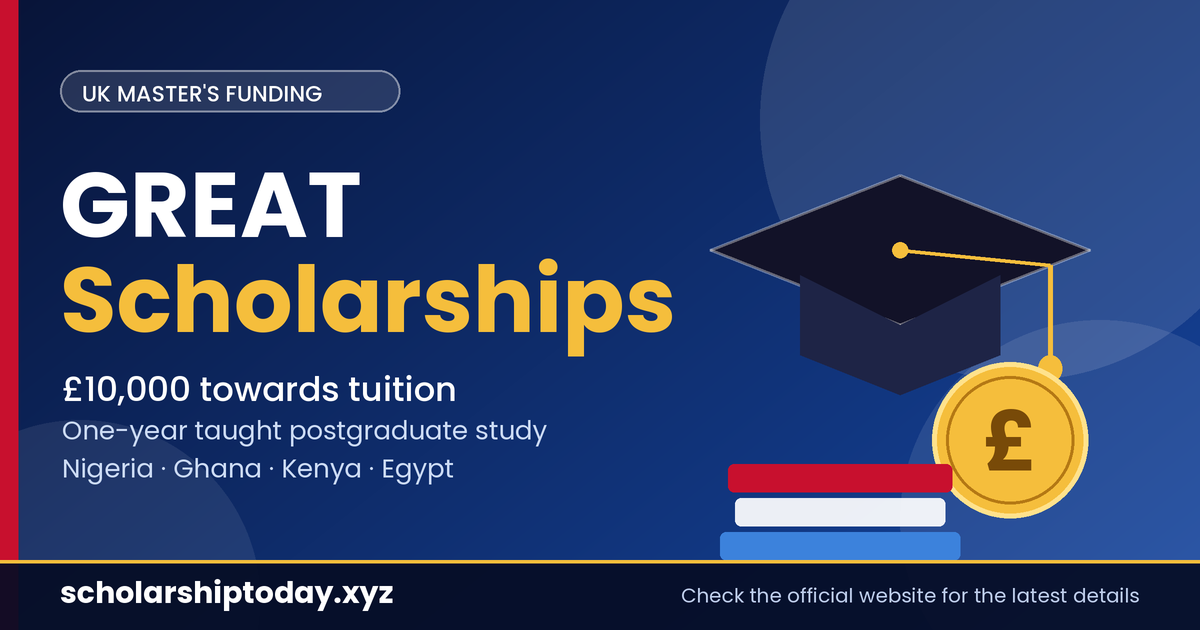
If you have dreamed of a UK master’s degree but the tuition bill keeps getting in the way, GREAT Scholarships deserve a spot on your shortlist. These awards are open to students from 18 countries, including four African countries (Nigeria, Ghana, Kenya and Egypt), and they give successful applicants £10,000 towards tuition fees for a one-year taught postgraduate course at a participating UK university.
The scheme is jointly funded by the UK government’s GREAT Britain Campaign and the British Council, together with the universities themselves. According to the British Council, more than 140 scholarships are on offer for the 2026-27 academic year across over 60 universities in England, Scotland, Wales and Northern Ireland.
That sounds exciting, and it is. But GREAT Scholarships are also easy to misunderstand. They are not fully funded. They are not for undergraduate degrees. And you don’t apply through one central portal. In this guide, I’ll walk you through what the award covers, who can apply, how to build a strong application, and the mistakes that quietly sink good candidates, so you can decide with clear eyes whether this scholarship is right for you.
Quick note on accuracy: Everything here is based on the official Study UK pages from the British Council. Universities, courses, deadlines and rules change from year to year, so treat this article as your map and the official website as your final authority.
What Do GREAT Scholarships Actually Cover?
Let’s start with the part everyone wants to know: the money.
Key benefits of GREAT Scholarships
- £10,000 towards tuition fees. The award is applied to your tuition for a one-year taught postgraduate course.
- Choice of universities. Each country has its own list of participating UK universities, and each university decides which of its courses carry a scholarship.
- A wide range of subjects. The official page describes the scholarships as available across a wide range of courses, so this isn’t limited to one field.
- Community events. All GREAT scholars are invited to a welcome event in the first semester and a networking event in the second semester. For many scholars, meeting peers from around the world is worth as much as the money.
- A recognised credential. Being a GREAT scholar signals to employers and future funders that you were selected competitively.
What GREAT Scholarships don’t cover
Here’s the honest bit. The official description refers to £10,000 towards tuition fees. It doesn’t mention living costs, flights, visa fees, health surcharge or accommodation. Depending on your course, tuition for international students can also be higher than £10,000, so the scholarship may reduce your bill rather than wipe it out.
Before you apply, do this simple exercise: write down the full tuition fee for your target course, subtract £10,000, and ask yourself how you’ll fund the rest plus living costs. If the answer is “I’m not sure yet,” that’s fine, but you’ll need a plan before you accept an offer.
Also worth knowing: the official application process says funding is issued to successful scholars by the university after registration. Ask the university’s scholarship office how exactly the money is applied (for example, as a reduction on your fee invoice) so you understand your cash flow in the first weeks.
Who Are GREAT Scholarships For? (Undergraduate, Graduate and Postgraduate Students)
This is where many applicants get confused, so let me be direct.
Postgraduate students (taught master’s): yes
GREAT Scholarships are designed for one-year taught postgraduate courses. In UK terms, that usually means a taught master’s degree such as an MSc, MA or MBA-style programme (check each course page to see exactly which programmes qualify).
Graduate students and recent graduates: yes, if you’re applying for a master’s
In everyday African usage, “graduate student” can mean someone who has just finished a bachelor’s degree, or someone already in a master’s programme. If you have completed an undergraduate degree and plan to start a one-year taught master’s in the UK, you’re the exact profile this scholarship is built for. The Nigeria page lists holding an undergraduate degree as a core requirement.
Undergraduate students: not for undergraduate study
If you want to do a bachelor’s degree in the UK, GREAT Scholarships are not designed for that. The scheme focuses on taught postgraduate study. That said, if you’re in your final year at home, this is a great time to start planning. Many successful applicants build their profile (grades, leadership, projects, volunteering) well before they apply. Other UK funding schemes exist for different study levels, so look at those too, and read our guides on the Chevening Scholarship and the Commonwealth Scholarship.
Research degrees (PhD or MPhil): check carefully
The official wording focuses on one-year taught postgraduate courses. Don’t assume a research degree qualifies. If you’re thinking about a PhD, look at other funding routes instead.
GREAT Scholarships Eligibility Criteria, Explained
Eligibility is set partly by the British Council and partly by each university, so always read both layers. The country page for Nigeria lists these requirements. I’ve added plain-English notes under each.
The core requirements
- You must be a passport holder and permanent resident of your eligible country. If you’re applying as a Nigerian student, the scholarship expects a Nigerian passport and permanent residence in Nigeria. If you’re from Ghana, Kenya or Egypt, check your own country page for the exact wording, as I only reviewed the Nigeria page in detail.
- You must hold an undergraduate degree. You need a bachelor’s degree (or equivalent) to be considered for a taught master’s.
- You must be motivated and genuinely interested in the subject area. Panels can tell the difference between “I want any UK degree” and “I’ve been thinking about this field for years.”
- You must meet the university’s English language requirement. Each university sets its own standard and accepted tests. Check this early, because test dates and results take time.
- You should be able to show real engagement with the UK as a scholar. The official criteria describe this as establishing engagement through personal and academic fulfilment. In practice, it means explaining what you’ll gain from the UK experience and why this course in this country makes sense.
The “give back” commitments
This is the part many applicants skim past. As a GREAT scholar, you’re expected to:
- Be willing to attend a networking event for GREAT scholars in the UK, where you’ll share your experiences.
- Stay in touch with the British Council and your university and act as an ambassador for the scheme.
- As an alumnus, occasionally speak to prospective candidates about studying in the UK.
None of this is heavy, but it’s a real commitment. If you’re happy to share your story, you’ll fit right in.
Eligibility traps to watch for
- Course eligibility. Not every course at a participating university carries a GREAT Scholarship. You must apply for an eligible one.
- Country-specific lists. The universities offering scholarships to Nigerian students are not identical to those offered to students from other countries. Always use your own country page.
- Extra university rules. Some universities add their own conditions. Read the university’s scholarship page, not just the headline summary.
How to Apply for GREAT Scholarships: Step by Step
The official process is simple on paper: visit the university page, follow the link to the university’s website, apply for the individual scholarship by following its instructions, and wait for the result. Here’s how to do it well.
Step 1: Confirm your country is eligible
The scheme covers 18 countries. For African applicants, that means Egypt, Ghana, Kenya and Nigeria. Open your country’s page on the official Study UK website and read the eligibility criteria and the university list.
Tip: Bookmark your country page. When you’re unsure about something later, that’s where you return first.
Step 2: Shortlist universities and courses
For Nigeria, the official page for 2026-27 lists these universities offering GREAT Scholarships: Brunel University of London, Cranfield University, Edge Hill University, Edinburgh Napier University, Imperial College London, Keele University, Nottingham Trent University, Royal Holloway (University of London), University College London, University of Bath, University of Kent, University of Reading, University of Southampton and University of Warwick. This list can change, so verify it on the official page.
Tip: Don’t choose by brand name alone. Ask yourself: Does the course fit my career plan? Is the tuition manageable after the £10,000? Does the university have the support and location I need? A well-matched course makes for a far more convincing application than a prestigious name with a vague reason attached.
Step 3: Read the university’s scholarship page closely
Each participating university has its own page explaining which courses are covered and how to apply. This is where the real details live: eligible courses, deadlines, whether you need an offer first, and any additional criteria.
Tip: Copy the key rules into a note or spreadsheet. If a page says “apply by [date]” or “submit before [step],” you want it in front of you, not buried in a browser tab.
Step 4: Check the English language requirement early
Find out which tests the university accepts and what score it expects. If you still need to sit a test, book it as soon as you can.
Tip: Leave a buffer for a retake. Nobody plans to need one, but a single missed score can derail your timeline.
Step 5: Prepare your supporting materials
Start requesting transcripts, certificates and references before you start writing your essay. For many students in Nigeria and across Africa, waiting for official documents to be issued can take longer than expected.
Tip: Ask your referees early and give them context: the course, the scholarship and your deadline. A rushed reference is rarely a strong one.
Step 6: Write your scholarship application
This is where you win or lose. Panels read your answers to understand who you are, what you’ve achieved, what you’ll do with the scholarship and how it connects to your home country. I’ve covered how to do this well in the insider tips section below.
Tip: Draft in a separate document, check the word limit, then paste into the form. Stick strictly to the word limit.
Step 7: Submit and keep proof
Submit before the university’s deadline, and keep screenshots or confirmation emails.
Tip: Submit at least a few days early. Portals slow down near deadlines, and a late-night upload failure is a painful way to lose a year.
Step 8: Wait for the university’s decision
Successful scholars are informed by the individual universities. If you’re successful, funding is issued by the university after registration.
Tip: While you wait, don’t stop planning. Research visa requirements, accommodation and your budget. If you’re unsuccessful, ask whether feedback is available, and consider other funding options.
Ready to start? Apply HERE (this takes you to the official GREAT Scholarships page, where you can select your country and university).
Required Documents Checklist
The official pages do not give one universal document list, because each university runs its own application. The checklist below covers what scholarship applications of this type commonly ask for. Confirm the exact list on your chosen university’s page.
- Valid international passport (matching your eligible country)
- Evidence of permanent residence in your country, if requested
- Undergraduate degree certificate and academic transcripts
- Evidence of English language proficiency (as required by the university)
- Completed scholarship application form
- Personal statement or short-answer responses
- Academic or professional references, if requested
- Updated CV, if requested
- Proof of admission or an application for your chosen course, if the university requires it
- Any extra documents named on the university’s scholarship page
Practical tip: Scan every document in clear, readable quality and name files sensibly (for example, “Surname_Transcript.pdf”). Small details like this save stress when a portal asks for six uploads at once.
GREAT Scholarships Deadlines and Timeline
I’m going to be careful here, because I will not invent dates.
What’s confirmed: The official page states that the deadline for GREAT Scholarships varies by institution. There’s no single universal closing date. You must check each university’s page.
What’s typical (general planning advice, not an official timeline): Most one-year UK master’s programmes start in autumn, so scholarship deadlines often fall in the months before. Because requirements differ, the safest approach is to work backward from your university’s deadline. Here’s a suggested planning rhythm:
| When | What to do |
| 9-12 months before your course starts | Research courses, check your country page, shortlist universities |
| 7-9 months before | Book your English test, request transcripts, contact referees |
| 4-6 months before | Draft and refine your scholarship answers, get feedback |
| 2-4 months before | Submit your university and scholarship applications (confirm exact deadlines) |
| After submission | Prepare finances, visa documents and accommodation research while you wait |
Important: This table is a planning guide, not official dates. Deadlines, application windows and course start dates differ by university and can change. Always verify on the official website and on each university’s scholarship page.
Common Mistakes to Avoid (and Insider Tips for Success)
Let’s look at where good applicants go wrong, and how to stand out.
Common mistakes
- Assuming it’s fully funded. Applicants who plan around “free education” often get a nasty surprise. Plan for the gap.
- Ignoring the word limit. Former GREAT scholar Diona, who shared her advice on the official blog, notes that meeting the eligibility criteria and respecting the word limit gets you through the first round, after which real people read your application. Don’t be filtered out for something so avoidable.
- Being modest to the point of invisibility. If you don’t share your achievements, the panel can’t give you credit for them.
- Writing generic answers. “I’m passionate about learning” could belong to anyone. Specific stories and goals are far more memorable.
- Forgetting the home-country angle. Panels assess your longer-term ambitions and the value you’ll add back home.
- Applying to a course that isn’t scholarship-eligible. Double-check before you submit.
- Leaving language tests and documents until the last minute.
- Using the wrong country page. Rules and university lists differ by country.
Insider tips that increase your chances
- Tell a story, not a list. Diona was told after winning that her honesty and flow of writing stood out. Think of your answers as a short story: where you started, what you did, what you learned, where you’re going.
- Share the small stuff too. Diona wrote about school activities, even a drama association, and focused on the skills those experiences gave her. Activities matter when you connect them to growth.
- Connect the scholarship to a concrete plan. Don’t just say you want to “advance your career.” Name the skills you want, the role you’re aiming for and how this specific course gets you there.
- Show how your country benefits. Whether it’s building a business, improving a health system, strengthening a policy area or training others, make the link between your studies and the people around you clear.
- Tailor each application. If you apply to more than one university, rewrite your answers for each. Copy-and-paste applications read like copy-and-paste applications.
- Get a second pair of eyes. Ask a lecturer, mentor or alumnus to read your draft for clarity, not just grammar.
- Be willing to try again. If you’re unsuccessful, ask for feedback where possible and use it next time. Many strong applicants succeed on a later attempt.
- Don’t put all your hope in one scholarship. Run a funding plan with several options alongside GREAT Scholarships, including the Chevening Scholarship.
Frequently Asked Questions About GREAT Scholarships
Are GREAT Scholarships fully funded?
No. The award is £10,000 towards tuition fees. It isn’t a full scholarship, and the official description doesn’t mention living costs or other expenses.
Which African countries can apply for GREAT Scholarships?
The four African countries on the official list are Egypt, Ghana, Kenya and Nigeria. The full scheme covers 18 countries. Always confirm on the official page, as the list can change.
Can undergraduate students apply for GREAT Scholarships?
No. The scholarships are for one-year taught postgraduate courses. You need an undergraduate degree to apply.
Can I use GREAT Scholarships for a PhD?
The official wording refers to taught postgraduate courses, so you shouldn’t assume a research degree is covered. Check the university’s page for the exact eligible courses.
Do I need an offer from the university before I apply?
It depends on the university. Read the scholarship page of your chosen university carefully, as the process is run by each institution.
Is there one central application portal?
No. According to the official process, you apply for individual scholarships by following the instructions on each university’s scholarship webpage.
When is the GREAT Scholarships deadline?
There isn’t one deadline. It varies by institution, so check the page of each university you’re considering.
How will I know if I’ve been successful?
Successful scholars are informed by the individual universities. Funding is issued by the university after registration.
Can I apply to more than one university?
The official pages don’t give a single rule that I can confirm here. Check the terms and conditions and each university’s page before applying to more than one, and don’t assume anything.
What are the responsibilities of a GREAT scholar?
You’re asked to attend a networking event, stay in contact with the British Council and your university, act as an ambassador for the scheme, and occasionally speak to potential candidates as an alumnus.
Conclusion: Your Next Steps for GREAT Scholarships
GREAT Scholarships won’t pay for everything, but £10,000 towards a UK master’s degree is a meaningful step, and the welcome and networking events add real value beyond the money. If you’re a Nigerian, Ghanaian, Kenyan or Egyptian graduate aiming for a one-year taught master’s, this is a scholarship worth your time.
Here’s what to do this week:
- Open your country page on the official Study UK website and read the eligibility criteria.
- Shortlist two or three universities and eligible courses.
- Note each university’s deadline and English language requirement.
- Start requesting your transcripts and contacting referees.
- Begin drafting answers about your achievements, your plans and the impact you want to make at home.
You don’t have to be perfect. You have to be clear, honest and prepared. If you’re asking yourself whether you should apply, take Diona’s “why not?” advice and give it a real shot.
Ready? Apply HERE
Author’s note: I’ve done my best to keep this guide accurate and useful, but scholarship details, university lists, deadlines and eligibility rules change regularly. Please double-check everything on the official British Council Study UK website and your chosen university’s scholarship page before you apply. Good luck, and may your application be a great one.