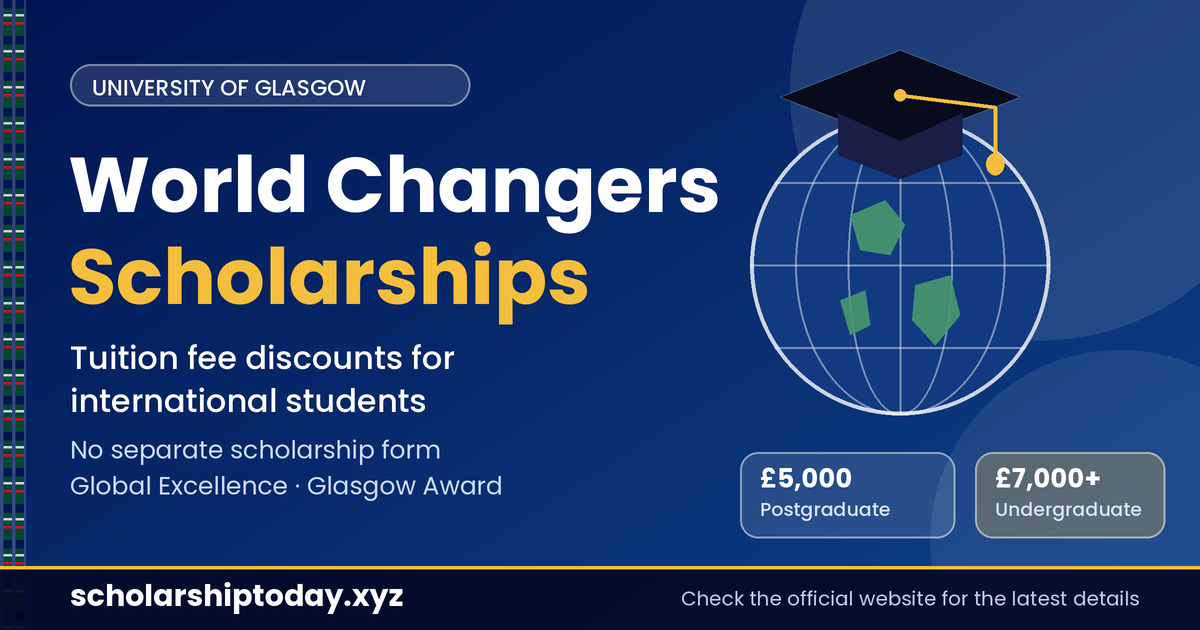
If you want to study in Scotland but the tuition fees are the part keeping you awake at night, the World Changers Scholarships at the University of Glasgow are worth understanding properly. There are two awards under this banner: the World Changers Glasgow Scholarship for taught master’s students from 19 countries (including Nigeria and Kenya), and the World Changers Global Excellence Scholarship for undergraduates from any country. Both come as a tuition fee discount, and, here’s the best part, neither needs a separate scholarship application.
The university says it has set aside more than £15 million in international scholarships to support students joining the Glasgow community. That’s a big pot, but it also means the rules matter. Which award you can get depends on your level of study, your nationality, your fee status and, for undergraduates, your grades.
In this guide, I’ll walk you through what each award is worth, who it’s for, how it actually works, and the practical things that decide whether you end up with the discount or miss out. I’ll also be upfront about what the official pages don’t say, so you’re never guessing.
Quick note on accuracy: This article is based on the University of Glasgow’s own scholarship pages as they appeared at the time of writing (October 2026). Amounts, country lists, programmes and intake years can change, so treat this as your guide and the official website as your final authority.
What Are the World Changers Scholarships? (The Two Awards Explained)
Let’s clear up the confusion first, because people often treat these as one scholarship. They’re two separate awards with different rules.
| World Changers Glasgow Scholarship | World Changers Global Excellence Scholarship | |
| Level | Taught postgraduate (master’s) | Undergraduate |
| Value | £5,000 tuition fee discount | £10,000 or £7,000 per year, depending on your College |
| Who can get it | Nationals of 19 listed countries | Applicants from any country |
| Fee status | International | International or EU (non-UK) |
| Application | Automatic, no separate form | Automatic, no separate form |
Both are awarded as a tuition fee discount, not cash. You won’t receive a payment into your bank account. The discount reduces what you owe the university.
Key Benefits: What the World Changers Scholarships Actually Cover
World Changers Glasgow Scholarship (postgraduate)
- £5,000 off your tuition fees. The discount is applied when you register.
- A large choice of programmes. The official page lists over 350 taught postgraduate programmes, from AI in Education to War Studies.
- No cap on the number of awards. The university describes the number of awards as unlimited, so you aren’t competing against other applicants for a fixed number of places. You simply need to meet the criteria.
- No separate application. The university tells you about your award soon after you receive your programme offer.
World Changers Global Excellence Scholarship (undergraduate)
- £10,000 per year if you study in the College of Medical, Veterinary & Life Sciences or the College of Science and Engineering.
- £7,000 per year if you study in the College of Arts or the College of Social Sciences.
- Renewable every year, as long as you make satisfactory academic progress.
- Automatic assessment once you hold an offer. You’re told about the award within about two weeks of receiving your offer, according to the official page.
What these scholarships don’t cover
This is the honest bit. These are tuition discounts, not full scholarships. The official pages don’t mention living costs, flights, visa fees, the immigration health surcharge or accommodation. If your tuition is higher than the discount, you pay the difference.
Do this simple exercise before you commit: take the full tuition fee for your programme, subtract the discount, then add a realistic budget for rent, food, transport, visa costs and flights. If you can’t see how to fund that total, you need a plan before you accept your offer.
Who Are the World Changers Scholarships For? (Undergraduate, Graduate and Postgraduate Students)
The label you use for yourself matters less than the level of the programme you’re applying to. Here’s how it breaks down.
Undergraduate students: the Global Excellence Scholarship
If you’re applying for a bachelor’s degree at Glasgow, the World Changers Global Excellence Scholarship is the one for you. It’s open to applicants from all countries, which is a big deal for students across Africa, including those from countries that aren’t covered by the postgraduate award.
Postgraduate taught students (master’s): the World Changers Glasgow Scholarship
If you’re heading into a taught master’s, this is your award. It’s limited to nationals of 19 countries: Brazil, Chile, Colombia, India, Indonesia, Israel, Jordan, Kenya, Lebanon, Malaysia, Mexico, Nigeria, Pakistan, Palestine, Singapore, Syria, Thailand, Vietnam and Yemen.
For African readers, that means Nigeria and Kenya are the two African countries on the list I reviewed. If you’re from Ghana, Egypt, South Africa, Uganda or anywhere else, you won’t find your country on that postgraduate list, so look at the university’s scholarships database and the other funding routes later in this article.
“Graduate” students: check which door you’re walking through
In everyday African usage, “graduate student” can mean a recent bachelor’s graduate heading into a master’s, or someone already in a master’s programme. If you’re about to start a taught master’s and you’re a national of a listed country, you fit the postgraduate award. If you’re already enrolled, the official page refers to applicants who receive a programme offer, so it’s aimed at new entrants. Confirm with the university if you’re in doubt.
Research students (PhD and research master’s): not covered by these two awards
The official pages for these two awards describe taught postgraduate programmes and undergraduate study only. The Global Excellence page also notes that it doesn’t state whether postgraduates are eligible, and it’s clearly framed as undergraduate. If you’re planning a PhD, don’t assume you qualify. Search the university’s scholarships database for research funding instead.
World Changers Scholarships Eligibility Criteria, Broken Down
Eligibility for the World Changers Glasgow Scholarship (postgraduate)
- Be a national of one of the 19 listed countries. It’s about your nationality, so check your passport against the list.
- Have international fee status. The university decides your fee status, so don’t assume.
- Hold an offer for an eligible taught postgraduate programme. Not every programme is guaranteed to be included, so verify yours on the official list.
- Start in the intake the page covers. At the time of writing, the page refers to the September 2027 and January 2028 intakes.
- Don’t have conflicting funding. The scholarship can’t be combined with other university scholarships, and it’s automatically withdrawn if you’re fully funded by an external sponsor.
What the page doesn’t say: it doesn’t state an English language requirement of its own, and it doesn’t give a deadline. English requirements are normally set at programme level, so check your programme page.
Eligibility for the World Changers Global Excellence Scholarship (undergraduate)
- Have international or EU (non-UK) fee status.
- Hold an offer for undergraduate entry in the year the page covers. The page I reviewed refers to 2027 entry.
- Meet your programme’s academic requirements. These vary by school and College. As examples on the official page: most programmes ask for AAB at A-level or 36 in the IB, while Law and first-year Computing Science ask for A*AA or 39, and some Psychology variants ask for AAA or 38.
The official wording is that applicants holding offers are automatically assessed. The page doesn’t give a total number of awards and doesn’t state a scholarship-specific deadline.
Conditions that apply to the undergraduate award
- It’s renewable each year with satisfactory academic progress.
- It can’t be combined with other university discounts or scholarships, with the Alumni Discount being the stated exception.
- If you’re offered more than one scholarship, the lower-value one is removed.
- If your award was based on predicted grades, it’s withdrawn if your final results don’t meet the requirement.
Eligibility traps to watch for
- Assuming your country is on the postgraduate list because a neighbouring country is.
- Forgetting that fee status is decided by the university, not by you.
- Treating predicted grades as guaranteed. For undergraduates, your final results matter.
- Taking an external sponsorship without checking what happens to your university award.
How to Apply: Step-by-Step (There’s No Separate Scholarship Form)
Here’s the part that surprises people. You don’t fill in a scholarship application for either award. The scholarship is attached to your admission process. In practice, your “application” is your application to the programme. Here’s how to do it well.
Step 1: Decide which award fits you
Match yourself to the table at the top: undergraduate or taught master’s, your nationality, and your College or programme.
Tip: Write down your level, nationality and programme in one line. If any of the three doesn’t match the criteria, you’ll know straight away and can look at other funding.
Step 2: Confirm your programme is eligible
For the postgraduate award, check that your chosen taught programme appears on the official eligible list. For undergraduates, check which College your degree sits in, because that decides whether the award is £10,000 or £7,000.
Tip: Two similar-sounding programmes can sit in different Colleges. Check before you get attached to one.
Step 3: Check the entry requirements and your timeline
For undergraduates, read the academic requirements for your programme closely. The university says it accepts many national school qualifications, and it assesses overseas qualifications using UK NARIC guidance. Use the international students section of the website and select your country to see what applies to your qualification.
Tip: Look at your actual or predicted results honestly. If you’re below the threshold, ask the admissions team what your options are before applying.
Step 4: Apply for your programme
For undergraduate study, international applicants apply through UCAS or the Common App. For postgraduate taught study, you apply directly through the university’s online system. The pages I could access didn’t spell out every step of the postgraduate process, so follow the instructions on your programme’s page.
Tip: Your application is the entire scholarship decision for undergraduates, because the award follows your offer. Take your personal statement and references seriously.
Step 5: Get your offer
The scholarship decision follows your offer. For the postgraduate award, the university says it will confirm your scholarship soon after you receive your programme offer. For the undergraduate award, the page says you’ll be told within about two weeks of your admission offer.
Tip: If you haven’t heard anything after a reasonable wait, email the admissions or scholarships team politely and quote your application number.
Step 6: Read your offer and scholarship letter carefully
Check the amount, the conditions and any grade requirements attached. If your offer is based on predicted grades, make a note of what you’ll need to achieve.
Tip: Save every email. If a condition ever becomes a question later, you’ll want a record.
Step 7: Accept and plan your money
The discount is applied at registration. Accepting your place is a separate step from the scholarship, so follow the instructions in your offer, including any deposit or payment requirements.
Tip: Ask the university how the discount appears on your fee invoice and what you need to pay up front. This avoids surprises in your first weeks.
Ready to start? Apply HERE. This takes you to the University of Glasgow’s official scholarships page, where you can read the award details and follow the links to apply for your programme.
Required Documents Checklist
The scholarship pages I reviewed don’t list documents, because the scholarship follows your admission application. The list below shows what university applications commonly ask for. Confirm the exact requirements on your programme page.
- Valid passport (it must match the nationality you’re claiming, especially for the postgraduate award)
- Academic transcripts and certificates (school results for undergraduates, degree certificate and transcript for master’s applicants)
- Evidence of English language proficiency, if required for your programme
- Personal statement
- Academic references, if requested
- CV, if requested for your programme
- Predicted grades, if you’re an undergraduate still in school
- Any programme-specific documents named on its page
Practical tip: Scan every document clearly and name files sensibly, such as “Surname_Transcript.pdf”. Official documents can take weeks to arrive in some countries, so request them early.
Important Deadlines and Timeline
I won’t invent dates, so here’s exactly what’s confirmed and what isn’t.
Confirmed from the official pages:
- The World Changers Glasgow Scholarship page doesn’t state a scholarship deadline. At the time of writing, it refers to the September 2027 and January 2028 intakes.
- The Global Excellence page doesn’t state a scholarship-specific deadline, and it refers to 2027 entry.
- The undergraduate admissions guidance gives 13 January 2027 at 18:00 UK time as the standard UCAS deadline. The university says it won’t consider late applications received after the deadline relevant to you and your programme.
What that means in practice: Because the scholarship follows your offer, your programme application deadline is effectively your scholarship deadline. At the time of writing, the January UCAS date is only a few months away for undergraduate applicants. Some programmes may have different deadlines, so check yours.
Here’s a planning rhythm for taught master’s applicants. It’s general advice, not an official timeline:
| When | What to do |
| 9-12 months before you start | Check the country list, shortlist programmes, confirm they’re eligible |
| 7-9 months before | Book your English test if needed, request transcripts, contact referees |
| 5-7 months before | Draft your personal statement and gather documents |
| 3-5 months before | Submit your application (earlier is safer; check the programme’s own deadline) |
| After your offer | Read your scholarship confirmation, plan finances, start visa preparations |
Important: This table is a planning guide only. Deadlines and intake dates vary by programme and can change. Always verify on the official website.
Common Mistakes to Avoid (and Insider Tips That Improve Your Chances)
Common mistakes
- Looking for a scholarship form. There isn’t one for these two awards. Your admission application is the route.
- Assuming the award is fully funded. It’s a discount. Plan for the rest.
- Applying to the wrong level. The undergraduate and postgraduate awards are separate, with separate rules.
- Assuming your country is eligible. The postgraduate list has 19 countries. Check your passport nationality against it.
- Ignoring the grade thresholds. For the undergraduate award, the grades on your offer are the gate.
- Forgetting that predicted-grade awards can be withdrawn. Your final results must match.
- Leaving it late. The scholarship follows your offer, so late applications can mean no offer, which means no scholarship.
- Taking external sponsorship without checking. The postgraduate award is automatically withdrawn if you’re fully funded by an external sponsor.
- Stacking awards in your head. The pages say these can’t be combined with other university scholarships, with one stated exception for undergraduates (the Alumni Discount).
Insider tips
- Treat your admission application as your scholarship application. Because the award is automatic, a polished, specific application is the thing you control. Explain why this programme and why Glasgow, and connect it to your plans back home.
- Compare the real value, not just the headline. A £5,000 discount on a one-year master’s covers a different share of the bill than £7,000 or £10,000 per year over a multi-year degree. Work out what you’ll still owe over the whole programme.
- Choose the College with your eyes open. For undergraduates, the College affects the award amount, but pick the degree that fits your goals first. A mismatched degree is a poor trade for a few thousand pounds.
- Ask early about stacking. If you’re hoping to combine a university award with another funder, ask the scholarships team before you accept, not after.
- Be clear about external sponsorship. If you apply for a government or foundation award, ask how it interacts with your university discount.
- Build a funding plan with several layers. Don’t rely on one discount. Look at other options such as the GREAT Scholarships, the Chevening Scholarship and other scholarships for African students.
- Keep every email. Offer letters and scholarship confirmations are your proof if anything needs checking later.
- Mention the Alumni Discount if it applies. The university’s international pages refer to an alumni discount for graduates. Ask whether it can be combined with the award you’re offered, because the rules differ between the two World Changers awards.
Frequently Asked Questions About the World Changers Scholarships
Are the World Changers Scholarships fully funded?
No. They’re tuition fee discounts. The postgraduate award is £5,000, and the undergraduate award is £10,000 or £7,000 per year depending on your College. The pages don’t mention living costs.
Do I need to apply separately for the World Changers Scholarships?
No. Both awards are made automatically to eligible applicants who hold an offer. The scholarship follows your admission application.
Which African countries are eligible for the postgraduate award?
On the list I reviewed, the African countries are Nigeria and Kenya. The list has 19 countries in total. Always confirm on the official page, as it can change.
Can students from any African country get the undergraduate award?
The official page describes the Global Excellence Scholarship as open to all countries, with international or EU (non-UK) fee status required. You still need an offer and must meet your programme’s academic requirements.
Can I get both the postgraduate and undergraduate awards?
They’re for different levels of study, so you would normally only be in one category at a time. The pages also say the awards can’t be combined with other university scholarships, apart from a stated Alumni Discount exception on the undergraduate page.
Can PhD students get these scholarships?
The official pages describe taught postgraduate and undergraduate study. Don’t assume research degrees are covered, and check the university’s scholarships database for research funding.
Is the undergraduate award renewable?
Yes, according to the official page, as long as you make satisfactory academic progress.
What happens if I’m offered more than one scholarship?
For the undergraduate award, the page says the lower-value scholarship is removed. Ask the scholarships team how your specific offers interact.
What if my award was based on predicted grades?
It’s withdrawn if your final results don’t meet the requirements.
When will I find out if I got the award?
For undergraduates, the page says within about two weeks of your admission offer. For postgraduates, the university says it will confirm your scholarship soon after you receive your programme offer.
Is there a deadline for the World Changers Scholarships?
The scholarship pages don’t state one. Your programme’s application deadline is what matters, since the award follows your offer. For undergraduates, the standard UCAS deadline cited is 13 January 2027 at 18:00 UK time.
Conclusion: Your Next Steps
The World Changers Scholarships won’t pay for everything, but a tuition discount of £5,000 for a master’s, or £7,000 to £10,000 a year for an undergraduate degree, is a real reduction in what you need to find. And because there’s no separate form, your job is simple: get a strong, on-time application in and make sure you meet the criteria.
Here’s what to do this week:
- Decide whether you’re aiming for an undergraduate or taught master’s programme.
- Check your nationality against the postgraduate country list, or confirm your fee status for the undergraduate award.
- Shortlist programmes and confirm they’re eligible.
- Note your programme’s application deadline and any English language requirement.
- Start gathering transcripts, references and your personal statement.
- Write down your full funding plan, including the money the discount doesn’t cover.
You don’t need to be perfect. You need to be early, honest and well prepared. If you’re wondering whether to try, remember that for these awards the cost of applying is simply the cost of applying to the programme you want anyway.
Ready? Apply HERE
Author’s note: I’ve done my best to make this guide accurate and useful, but scholarship amounts, country lists, eligible programmes, intake years and deadlines change regularly. Please double-check everything on the University of Glasgow’s official website and with the admissions team before you apply. Good luck, and may your application go all the way.